Happy Independence day (from US tech)
The first few months after moving for work to the core of Silicon Valley I kept randomly stumbling into the offices of Redhat, Pinterest, Adobe, Amazon, etc.. without really wanting to. It was just part of going around places. With that, a slow but inescapable realization also started taking shape: every flipping bit of digital tech I used was coming from that place. Brands and logos that I had only seen in digital shape were now occupying my same physical space.
When I was living in Italy or in the UK that small innocuous fact had no real consequence: Silicon Valley was just a place somewhere on a map: of course every digital revolution came from there, it was in the name, after all.
However (see Taking a break from corporate America) now that I was living there I had a much more concrete idea of what Silicon Valley really meant to me, outside of the Hollywood dramatisations that dominated the collective imagination (and consequentially mine too).
By January 2024, I had walked many times in the downtown of Mountain View (the city that hosts the main campus for Google) and realized that its main street had very little to offer, and was actually considerably sadder than the one of my small home town in Italy. The low-rise architecture was pretty uninspired and carried a patina of 'newly built holiday village', while the small bookshop and local grocery store were the only partial highlights of Castro Street. The experience of having disgusting "Italian" ice-cream just a couple of buildings down from Paris Baguette truly helped cement the idea that Silicon Valley is a very real place and its people can also have really bad taste. In short: nothing is magical just because it comes from there.
Those first few months of living in the Bay Area played a fundamental role in removing the veil of Maya I had over that place (or, as we'd say in Italian: the slices of prosciutto covering my eyes). It was like meeting a famous actor and realizing they also fart and stink every once in a while. It's not like you don't know that it's true, it's just that you never thought you'd be the one experiencing it.
Peeling away more prosciutto
Removing this thick layer of idealisation was also facilitated by my time working at Apple. My early 20s were deeply influenced by the Steve Jobs biography (by Isaacson) and Jobs, the movie with Ashton Kutcher, so seeing how the company actually operated from the inside (in a dull cult-like way) helped me realize there were genuine problems with the whole construct of Silicon Valley. Every day I started thinking more and more about the invisible connection that I had built with that place for all of these years, and I started thinking deeply about how many of the people working in those buildings were influencing my life from a distance.
The emails that I check every day? They ran through Google servers, whose biggest campus in Mountain View I had visited a few times. The smartphone I used daily for the last 5 years or so? Designed and programmed across the Apple offices in Sunnyvale and the boring-ass spaceship in Cupertino. The design and philosophy of so many UIs I relied on came from a bunch of people living in dull towns in the North of California.
Now I was feeling a bit offended that I had let such a barren and uninspiring place dictate so much of the design and aesthetics of my digital life.
I thought I'd find people with challenging ideas and interesting views of the world. But the reality was way different: people worked at Apple because they were born close to California. They were just lucky (or priviliged), but talent didn't play as much as a role as I thought it would. It was just another job, a well-paid one for sure, but there was nothing groundbreaking or uniquely magic about it. In my opinion, people are what makes a place special, and in my first year or so I had seen so much mediocrity at large (both outside and inside of my own org) that it was really impossible to continue dreaming up that there was some kind of special meaning to that place. In turn, this started to spiral outwards, including not just how I felt about the Bay Area or Apple, but also California and the USA as a whole.
It's definitely not a 'rational' idea, and one should not just judge 350 million people based on a limited experience in a particular bubble. Yet, a process of revisiting how I felt about the USA as a whole had started inside me and in reality I had very little control about my general sense of disgust with my own past self for having believed that somehow the Amerrrrican tech dream was more inspired than people talking stocks at lunch all day.
Trumping further enthusiasm
Then the 2024 election happened. I vividly remember thinking, with the very naive understanding I had of US geopolitics, that it was impossible that somebody convicted of so many crimes would become president. This was not Italy, after all. Outside of the ideology attached to its campaign (and for sure I wasn't aligned with anti-immigration and national-populistic propaganda), in my world view it was fundamentally impossible that Trump could win. The whole drama would be settled through a fair legal process that would have ruled out its participation once and for all.
Of course, that's exactly what didn't happen.
All of a sudden, on top of the burden of slowly realizing that Silicon Valley wasn't really a land of digital fairies, I also had to carry the weight of realizing that nothing was truly fair in the USA. Any last semblance of American dream was shattered. A lot of my colleagues were genuinely desperate in the first weeks of 2025 and seeing how they were feeling reminded me of the deep red/blue split that runs in the country, a little bit like Italy. The thought that Nevada had flipped didn't help either, given how close it was to us.
Seeking help
The only way that I could find some sort of solace was by making sure that I wasn't alone in realizing that the mask of what America represented had fallen. My family was also starting to see through the cracks of US ideology, but their process was much slower due to the cultural legacy that America carries amongst Italians, especially since the collective memory of the American troops helping us during the "Battle of Anzio" in WW2 is still very fresh (and real, as the American cemetery in Anzio reminds us every time we go to the sea). Plus, my family didn't live and experience the US like me, so it was really for me to translate what it meant to feel that "Trump" was my president and Tim Cook (who was licking his boots without a spine) my CEO.
Luckily (?!), my online bubble starting changing as well, also rallying against the USA just like me.
I started getting recommended YouTube videos that were not just critical to the current US administration, but in general to mainstream USA culture that focused too much on fast food, big cars and no public transportation. More and more social media creators were capturing this general sense of revolt, even if I wasn't necessarily searching for it. It was at this time "Morning Brew" and "A More Perfect Union" appearing in my various feeds, too. My friends kept sending me memes about how terrible the ICE situation in the US was, and to be honest, I was fully agreeing with them, especially since I could witness personally how much political propaganda I would get camouflaged as ads (I'll never forget the Trump campaign related recommending to immigrants to 'self-deport').
By this point, I started getting posts from many online communities that I would have never thought of joining, like r/BuyFromEU, r/Degoogle and r/Demeta. I had been a strong critic of Meta since its very beginning and the days of Cambridge Analytica were just a confirmation of their evil for me, but it always really felt like a lonely fight, especially in Europe where everybody used Whatsapp and Instagram without thinking twice about alternatives. But now it felt that something akin to a class consciousness was starting to take shape..
Bye bye (American) Tech ?
To be sure I'm not just making this "collective consciousness" thing up, let's look at when some of those communities were formed. For example, both r/BuyFromEU and r/Demeta are from early 2025:
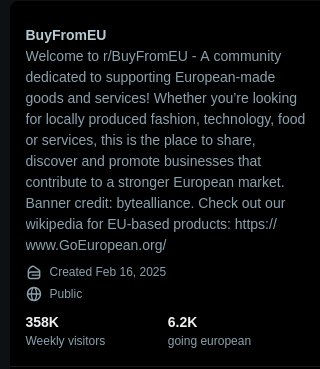
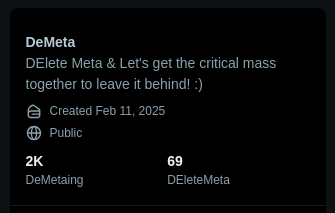
While if we look at Degoogle, another movement that I feel got more prominent in the last few years, it started in November 2017 (that's probably because as a result of the big anti-trust case where the EU hit them with a $2.7 billion fine) :
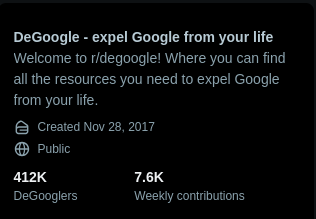
Let's broaden the search, here's a few more:
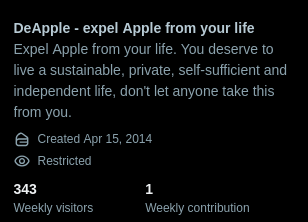
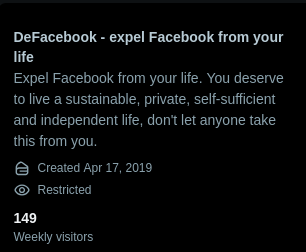
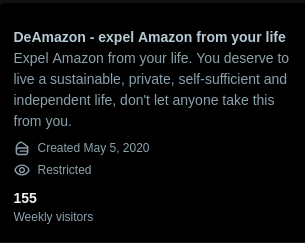
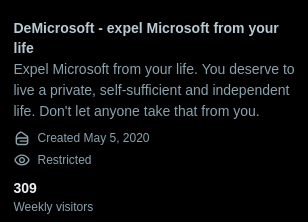
It's hard not to notice how these last 4 are basically copy-pasted as-is, and it makes me want to wear a thin foil hat and claim something's up. But maybe they just have the same lazy creator.
Just to spice things up, one funny outlier that has been cooking for a long time is this:
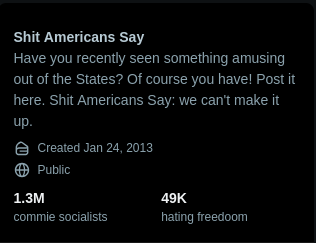
Does the emergence of these communities reveal anything deeper?
I don't know, but to me it surely looks like the last 10 years of American technology innovation have made a few victims, and the last couple of years of politics helped accelerate the problem.
Maybe it's just one more sign that enshittification is real, and it just so happens that US tech companies have been consistently good at enshittifying their products while truly alienating the people that used those products daily. I can think of a few non-US-but-equally-enshittifying companies, like BWM and their famous Heated Seat As A Service moment, but I can't yet find any trace of an equivalent r/debmw movement.
Or maybe it's not just in my head, and there's a growing sense of aversion to US tech.
It's hard to tell, especially since we're also witnessing the looming shadow of American AI tech companies once again fiddling with our digital lifes, letting us play the despicable game of "is this photo real or AI-generated?" for no good reason other than some corporate person wanted to make images of dinosaurs dressed in pajamas and running on roller skates (by the way this is not just a random image, when I was at Apple this was literally an example given during one of the internal trainings I had on Generative AI).
Anyone that once found the internet as the best place to access and navigate the world's collective knowledge (not just doomscrolling and watching cat memes) should at least raise an eyebrow at the prospect of no longer being able to tell apart facts from manufactured fluff.
I won't pretend I'm a fully objective observer without any bias, as I'm quite deep fighting my own personal battle to conquer back digital independence after realizing that I have stayed far too long into the walled garden of Apple and I got too complacent for the sake of practicality. But I do genuinely find it depressing to realize that what I needed in order to be awakened from my 'dogmatic slumber' (to borrow an expression from Kant) was a couple of years living in the Bay Area working for a FAANG, aided by a photo of Tim Cook donating a 24-karat base to the president of the United States. All of this while taking Business Conduct training explaining how every Apple employee is subject to a 'no-gifts' policy. And let's not forget that Severance was trending on Apple TV+ at the same time. Not everybody will have the privilege to live such traumatic experiences, but most of us still live our whole life one US presidency away from (further) digital enshittification. One executive order away from asking Google Maps to rename the Gulf of Mexico.
This is something I realize more and more as I chat with folks here in London about my experience in the US, which always seems to come as very surprising. I guess years of media manipulation selling the US lifestyle through Hollywood have done their work properly.
Rebooting
Because I want to end this on a bright note, and fully celebrate this 4th of July as a day of independence, I'm happy to report that I finally started my migration away from Digital Ocean, a US service I've been happily using since March 2017 (so a decade as I write this). If I can vote for my wallet, I will vote to stop using digital infrastructure that brings more money to US companies. Even if it's just a mere droplet in the ocean..
After an agonizing afternoon ranking details of European Cloud and VPS providers, I chose to go with OVH and see how things go. But I'm not here to sell recommendations for anybody - the other alternatives (like Hetzner, IONOS, netcup, etc.) looked fine too.
I guess it's just that I vibe with the French more at this moment of my life...
Stats for nerds
Before, with Digital Ocean, for $14.40 per month I had this VM:
$ df -h
Filesystem      Size  Used Avail Use% Mounted on
/dev/vda4        23G   13G   11G  55% /
[..redacted..]

$ free -h
               total        used        free      shared  buff/cache   available
Mem:           947Mi       654Mi        76Mi       3.0Mi       354Mi       292Mi
Swap:          946Mi       714Mi       232Mi
Now for £8.88 on OVH I get this:
$ df -h
Filesystem      Size  Used Avail Use% Mounted on
/dev/sda3        75G  1.5G   74G   2% /
[..redacted..]

$ free -h
               total        used        free      shared  buff/cache   available
Mem:           7.6Gi       623Mi       5.1Gi       4.7Mi       2.0Gi       6.9Gi
Swap:          7.6Gi          0B       7.6Gi
With the current USD to GBP change, that's around $11.88.
¯\__(ツ)__/¯
PS: A nice website to compare the EU offering in terms of cloud infrastructure is EU Cloud Cost: https://www.eucloudcost.com. I recently discovered it and there's some interesting data in there.